Month: March 2004

  • I Lost My Password

    How usable is security? It’s a question I’ve been asking myself
    lately. One of the courses I attended last semester was about cryptography and
    secure design. What got me thinking is the fact that security is just 20% technology—80%
    is organizational. Security is about people—about trust.

    The thing is, the more you try to make a system secure the less usable it becomes—and
    as a result, the system actually becomes less secure than its designers intended.
    Do you use different passwords for an assortment of accounts you are subscribed
    to? Do you change your passwords frequently? I certainly don’t. Security
    is always a trade-off between convenience and complexity. People don’t
    like complexity, and definitely not at 8:30 in the morning when they need to
    log in to start working.

    If you ask users to memorize too many passwords they will start sticking post-it
    notes on their screen to make sure they don’t have to call tech support.
    How secure is that? You just spent 6 months and a few million bucks to end up
    with bright yellow post-it notes all over the place with confidential information.
    That’s why security is about people, not technology.

  • Weekend Reading (13)

  • Weekend Reading (12)

  • Ridiculously Cool Comment Tools

    The blogosphere is being all innovative. Way to go! I’ve observed some
    very cool comment tools and features over the last couple of days. I’m
    supposed to study hard for my last ever exam in my master degree. Oh well, you
    know how that goes. Thus it was new blog checking time (so much for effective
    time management).

    Comment Preview

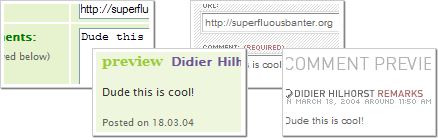
    This is a very useful tool not only because it’s user friendly but also
    because it’s just plain smart. Less server requests, less load and best
    of all — less bullshit. I spotted this cool feature on blogs by Jon
    Hicks
    and Shaun Inman.

    Live comment preview

    These two examples just look so damn lickable™ and are smartly implemented.
    You can read how
    Jon put this nifty feature on his blog
    by checking his entry about the whole
    process and the code behind it.

    Comment Textarea

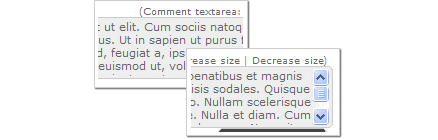
    Aren’t tiny textareas a pain in the butt? Whatever, I think they are.
    I hate scrolling all the time to see what I typed or make adjustments. But fear
    no more, someone thought of a solution. I spotted this new (atleast to me) feature
    on Binary Bonsai — blog of a scandinavian
    fellow by the name of Michael Heilemann. By the way his website is worth a visit
    — not only does he have good taste, his content is worthwhile too!

    Change comment textarea size

    Pretty cool stuff, eh? I think both these tools dramatically increase user
    experience on blogs and make adding comments a breeze. Have you spotted other
    cool new features? If so, let me know in the comments.

  • Websites Have Two Layers

    To keep this post focused and simple I will assume that websites have two layers:
    design (UI/presentation) and code (technology/mark-up). Which layer is most
    important in building a succesful website? Both you will say. But in the end
    the web is about interaction. Jason
    Fried at 37signals on the topic
    :

    “There’s way too much talk about CSS and XHTML and Standards and
    Accessibility and not enough talk about people. CSS and Standards Compliant
    Code are just tools — you have to know what to build with these tools.”

    People, people, people! Web design is a bit like a car —
    the engine (technology) and everything else that makes using it bearable (interface).
    Over at the wonderfully designed Airbag, thoughts
    of Greg Storey
    follow a similar pattern:

    “Now I’m all for a good conversation and exhibition of great design work
    but enough is enough. Web standards and style sheets are here to stay (ya hooray!).
    It’s time to move on. So let’s talk about money and metrics.”

    So? Is the fuzz about XHTML, CSS and other new exciting technologies over?
    Can we move on? If you buy a car you assume its engine will function. Nowadays
    there are no shamelessly bad engine manufacturers left. What really differentiates
    brands such as Ford, BMW and Volkswagen is the experience they sell. The automobile
    industry is a mature industry. The web is not — yet. Look around. Do we
    see standard compliant code everywhere? Can we assume websites have solid mark-up?

    Personally I agree with both Jason and Greg. Yet I think they’re looking
    in the wrong places. The blogosphere tends to talk about code. Yadi yada validation
    yada yadi standards yada yada. We are part of a small group that cares and knows
    about good mark-up. But there’s more happening around us. SxSW
    is not solely a user experience conference, nor is it purely a design event.
    SxSW just happens to attract a lot of people talking about CSS. Leave the coders
    do the talking about what they know best: clean mark-up. They should not stop
    innovating or spreading the word — on the contrary.

    If I want to discuss all things user experience I post a message to CHI-WEB,
    check the latest news at Information
    Design
    and have a good laugh with the folks from OK/Cancel.
    Oh, and maybe even read what Jakob Nielsen
    has to say. It’s not a matter of “or”, it’s a matter
    of “and”. We need both. I focus on design, not code — it’s
    what I do and talk about. If you want to change the industry put your money
    where your mouth is, but don’t tell people to stop doing what they love.